Stop Treating AI Like a Chatbot. Start Treating It Like a System.

Most people use AI like a search engine. Ask. Get an answer. Move on.
The people getting real leverage have stopped doing that. They’ve built a system. A system with parts, governance, and a direction. Not a better search engine. Something else entirely.
There are seven parts.
Identity is who the AI thinks you are. Your goals, your values, how you want to be communicated with. Save it as a text file. That file is the foundation everything else sits on. Without it, you’ve got a stranger answering your questions.
Context is everything you know about what you’re working on. It’s the difference between asking “what’s a good email subject line” and asking “what’s a good email subject line for this client, with this audience, this brand, and this goal.” One gives you generic. The other gives you useful.
Memory is how the AI navigates the system you’ve built. What folders, what skills, which context matters right now. Without memory, the AI is wandering around with the lights off. It’s also where corrections accumulate. Good memory means you don’t have to teach the same lesson twice.
Skills are the repeatable bits. The twenty processes you already use to get a specific outcome. To turn one into an AI skill, you walk it through what you do, it asks the gaps, you answer them. It won’t be great the first time. Or the second. That two-week investment of plugging gaps and refining steps is the moat. It’s also why most people give up after one disappointing try.
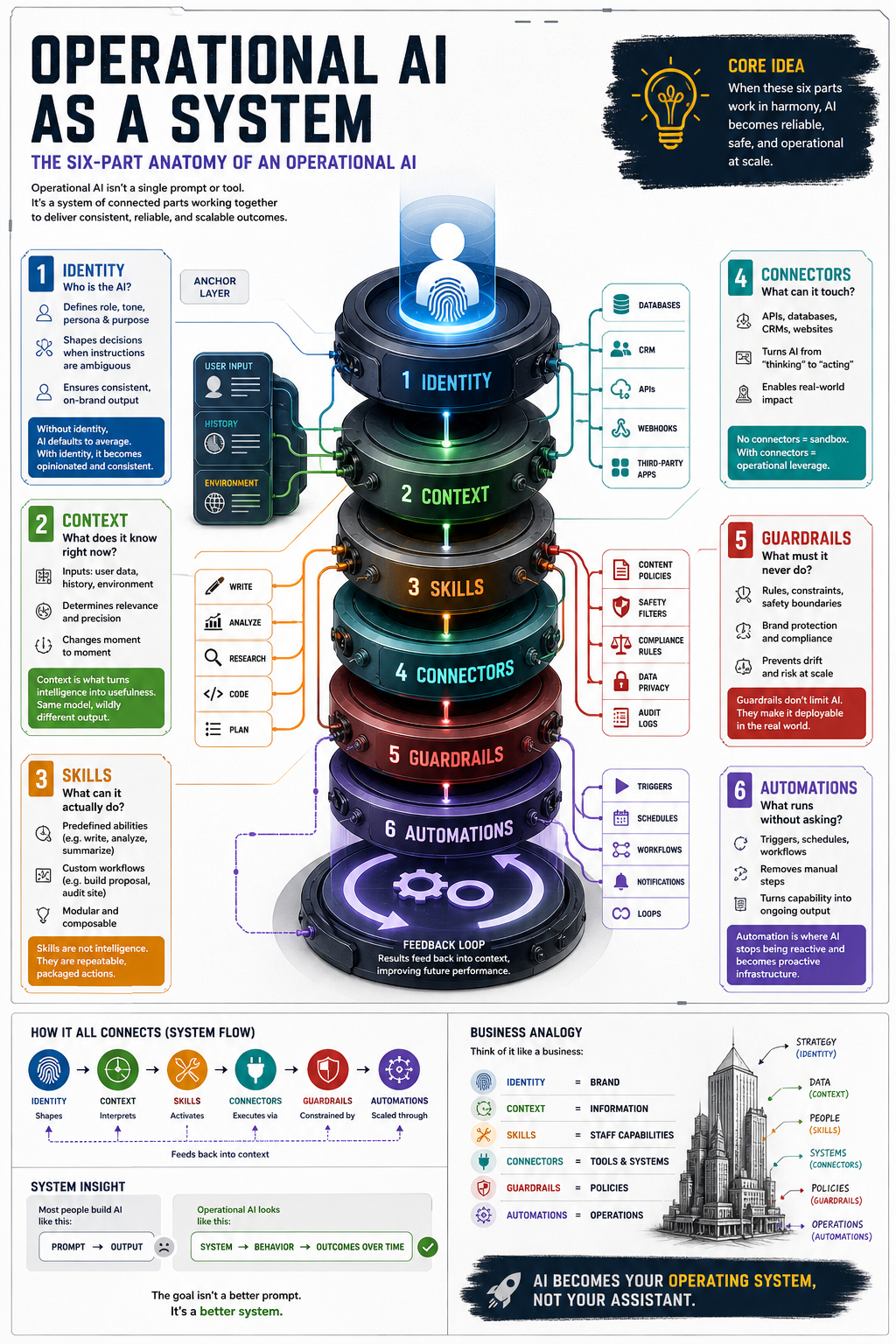
Connectors are how AI steps into your real world. Email, calendar, task manager. Every connector you add expands the surface area. Every new permission multiplies the exposure. Go carefully.
Guardrails are how you keep the system from hurting you. Read-only access first. Always. Then hard limits in plain English that the AI reads every time it starts. Always draft emails. Never send without approval. Never publish anything externally without checking in.
Automations are the payoff. Once a skill is mature and trusted, you can schedule it to run without you. AI working while you sleep. The rule is simple: only automate what’s already proven.
AI models are converging. Capability is becoming a commodity.
What isn’t becoming a commodity is system design. Identity, context, memory, skills, connectors, guardrails, automations. The quality of those, and how they fit together, is the actual differentiator.
Pick a model, sure. But spend your time building the system underneath it. That’s where the leverage is.