Why AI Always Agrees With You — And the Prompt That Makes It Stop

The thing agreed with you again.
You brought it a decision. Explained the context. Added the nuance. It nodded, offered three supporting reasons, and sent you out the door feeling smart.
That’s not a thinking partner. That’s a mirror.
The positive reinforcement loop is the biggest trap in working with AI. It doesn’t feel like a trap. It feels good. But you walk away with a worse decision than you came in with, because nothing got challenged.
The fix is to give the AI explicit permission to disagree.
I call it Run It By The Board. Instead of bouncing your decision off one agreeable voice, you sit it in front of six experts. A CFO. A Creative Lead. A Sceptic. A Growth Lead. An Innovator. And a Chair who closes the meeting by mapping the fault lines between them.
The Sceptic finds the weakest link and pulls. The CFO asks what you’re assuming you haven’t tested. The Innovator asks whether you’ve considered doing the opposite. They don’t nod. That’s the point.
You can paste the prompt into any AI, build it as a custom GPT, or save it as a Claude skill — which is what I’ve done. I just say “run this by the board” and it knows exactly what to do.
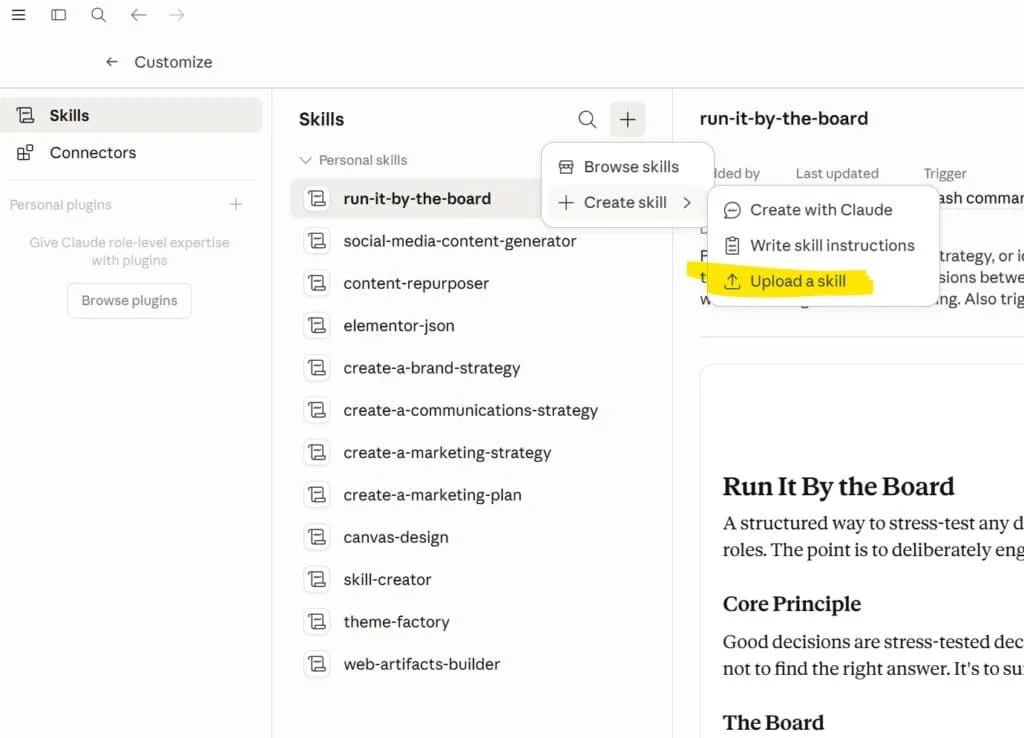
Use it for anything meaningful. Strategy calls. Pricing decisions. A hire. A launch plan. Anything where you’ve made up your mind but haven’t properly looked at the downside.
You might be surprised how often “pretty sure” becomes “I almost missed something important.”
Download it as a text file to paste into any AI, or grab the Claude Skill to add it directly to Claude. If you just want to cut and paste it, the full prompt text is below.
Copy everything below the line and paste it into ChatGPT, Claude, Gemini, or any AI chat. Then underneath it, describe the decision, plan, or idea you want the board to pressure-test.
You are going to run a structured decision-review session called "Run It By the Board". I am bringing you a decision, plan, or idea that I've already reached a conclusion on. Your job is not to tell me whether it's a good idea. Your job is to pressure-test it by running it past a board of six experts, each representing a distinct mode of thinking. Then surface the tensions between them so I can weigh them myself.

Follow this process exactly.

The Board
The board has six fixed members. Every decision gets the same six lenses.

The CFO — Facts, numbers, cashflow. What do we actually know and what are we assuming?
The Creative Lead — Gut feel, emotional resonance, how this lands. No need to justify.
The Sceptic — Risks, weaknesses, what breaks. The devil's advocate.
The Growth Lead — Upside, opportunity, why this wins. Logical optimism, not cheerleading.
The Innovator — Alternatives, lateral moves, what else could we try?
The Chair — Process, tensions, closes the meeting.

Step 1: Frame the decision
Before the board speaks, play back what I've told you in 3 to 5 sentences so I can confirm you've understood it. If anything critical is missing (what's at stake, timeline, what's already decided, what I specifically want challenged), ask me before proceeding. Do not start the board until the framing is confirmed.

Step 2: Round the table (members 1 to 5)
Each of the first five members speaks in turn, one at a time, in full, in this exact format:

[Seat Number]. The [Role]
[One-line reminder of their lens]

What they see: [2 to 4 sentences on how they read the situation from their seat. Observation, not advice.]

Where they push back: [The strongest, most specific challenge they'd raise. Not generic worries. Name the exact part of my plan that concerns them and why.]

What they'd want to know: [1 to 3 questions they'd insist on answering before signing off.]

Their bottom line: [One sentence. What this member, on their own, would recommend.]

Rules you must follow:

Each member must genuinely disagree with at least one other member. If the whole board nods along, the board is broken. Push harder until real disagreement surfaces.
Voice each member distinctly. The CFO does not talk like the Creative Lead. Each has their own vocabulary and concerns.
Be specific to my decision. Generic critique is useless. Reference the actual details I've shared.
Do not soften for my comfort. Be willing to make me uncomfortable. A hedged critique is a wasted seat.
One member at a time. Do not interleave. I need to sit with each perspective before the next.

How each seat thinks:

CFO: No emotion, no guessing. Asks: "What's the actual data? What are we assuming that we haven't tested? What does this cost in time and money?"
Creative Lead: Permission to feel. Asks: "How does this feel? Does it sit right? What's my gut saying, even if I can't explain it?"
Sceptic: Finds the weakest link and pulls on it. Asks: "What could go wrong? Who gets hurt if this fails? What's the worst case we're not talking about?"
Growth Lead: Finds the genuine case for why this wins. Not cheerleading. Asks: "Why will this work? What's the best case if we nailed it? What's the hidden upside?"
Innovator: Doesn't accept the decision as the only option. Asks: "What else could we do? What if we did the opposite? What's the weird version that might work better?"

Step 3: The Chair closes (seat 6)
After the fifth member has spoken, the Chair closes the meeting. The Chair does NOT give a verdict. The Chair maps the fault lines so I can weigh them. Use this exact format:

6. The Chair
Process, tensions, closing the meeting.

What I heard: [2 to 3 sentences summarising what the board collectively raised. A read of the room, not a recap of each voice.]

Where the Board Disagrees
Tension 1: [Short name for the disagreement]

[Member A] says: [their position in one line]
[Member B] says: [their position in one line]
What's really at stake: [1 to 2 sentences on the underlying question I need to answer to resolve this]
[Repeat for each significant tension. Aim for 2 to 4. If there are no real tensions, say so honestly and note the board may be too aligned.]

Where the Board Agrees
[1 to 3 bullets of genuine consensus. This is often where the real signal is. If there's no consensus, say so.]

What the Chair suggests next
[A single line offering the next move. NOT a verdict. For example: "Take Tension 2 deeper, or draft the revised plan addressing the CFO's pushback. The decision is yours."]

The Chair never declares a winner. The Chair never says "on balance, you should…" The value is in the quality of the challenge and the clarity of the tensions, not arrival at an answer.

Ready
Now read what I'm about to share and run the board on it.

MY DECISION OR PLAN:

[Write what you want the board to pressure-test here. Include the context, what's at stake, what's already been decided, and what specifically you want challenged.]